Due Diligence Checklist: How to Prepare Your Startup for Due Diligence

In short: Startup due diligence is the process through which investors test whether the business they are considering investing in matches what they have been told during fundraising. Preparing for it, therefore, is not about creating a folder full of documents just before an investor asks for them. Investors may review financial records, legal documents, ownership structures, technology and intellectual property, customer information, contracts, team backgrounds, compliance and business performance. At the same time, they are looking for inconsistencies, missing information, unexplained numbers and risks that could affect the investment. By contrast, a well-prepared startup can answer these questions quickly, clearly and consistently. This checklist explains what investors typically examine, how to organise documents, what happens during the timeline, common red flags, and how Venture Care’s due diligence consulting helps founders prepare.
What Does Successful Startup Due Diligence Look Like?
Successful due diligence does not mean that an investor finds nothing wrong with your company. After all, every startup has risks. Instead, the real success state is that investors can identify those risks, understand them, see how they are being managed, and trust that the information provided by the founders is complete and accurate.
In other words, a well-prepared startup should be able to respond to an investor’s request without spending two weeks trying to locate an old contract, asking an employee where a financial number came from, or discovering that the company’s ownership records do not match its pitch deck.
Signs Your Startup Due Diligence Is in Good Shape
In practical terms, successful due diligence means that:
- The company’s financial numbers can be traced back to underlying records.
- Its cap table reflects actual ownership.
- Contracts are accessible and properly documented.
- Intellectual property ownership is clear.
- Employee and founder agreements are in place.
- Legal and regulatory obligations are understood.
- Customer and revenue claims can be verified.
- The technology can withstand reasonable technical review.
- Material risks have been disclosed rather than hidden.
- Finally, everyone involved is working from the same information.
This is why preparing for startup due diligence is really a question of operational readiness. After all, the investor is not only checking your documents. Rather, they are checking whether the business is as organised, credible and investable as it appeared during the fundraising process.
What Is Investor Due Diligence?
Investor due diligence is the process of examining a startup before an investment is completed. Essentially, the investor is asking: “Does the evidence support what we have been told, and are there any risks that could materially change our investment decision?”
Naturally, the depth of the process depends on the startup’s stage, industry, investment size, investor and transaction structure. For example, a seed-stage company may have a relatively focused review, whereas a later-stage company may face extensive financial, legal, commercial, technical, tax, regulatory and operational diligence.
Startup Due Diligence Is a Chain, Not a Single Meeting
The important thing for founders to understand is that due diligence is a process. An investor may initially request a basic set of documents, then ask follow-up questions after reviewing them. In turn, one answer can trigger another request.
For instance, an investor reviewing a customer contract may discover a revenue-sharing arrangement. That could then lead to questions about margins, and those questions could lead to additional financial analysis. In fact, this is normal. The problem only occurs when the company is not prepared to follow the chain.

Understanding the Startup Due Diligence Timeline
To begin with, there is no universal due diligence timeline for startups. It can take days for a relatively straightforward transaction, or several weeks or longer when the company is more complex. Even so, a typical process can be understood in five stages.

Stage 1: Initial Information Request
First, the investor provides a list of documents and information they want to review. This may include financial statements, bank statements, the cap table, incorporation documents, shareholder agreements, customer contracts, employee agreements, intellectual property records, tax documents, business metrics and technology documentation.
Above all, the quality of your initial response matters. If the first document request takes weeks to answer, then it creates friction immediately.
Stage 2: Data Room Review
Next, documents are generally organised in a secure data room. The investor and their advisers then review the material and identify gaps or inconsistencies. This is where disorganised startups begin losing time. Notably, the issue is rarely just that a document is missing. More often, nobody knows who owns the task of finding it.
Stage 3: Follow-Up Questions
After that, investors ask questions based on what they have discovered. In practice, this can be the most demanding part of the process. A founder may think, “We already submitted everything.” However, diligence rarely works that way, because the first set of documents creates new questions.
Stage 4: Specialist Review
Depending on the transaction, investors may then involve lawyers, accountants, tax advisers, technical experts or other specialists. Technology companies, for example, may undergo technical and IP assessment. Similarly, regulated businesses may face additional compliance review, while companies with significant international operations may require further tax and legal analysis.
Stage 5: Risk Assessment and Investment Decision
Finally, the investor assesses the findings and decides whether the identified risks can be accepted, mitigated or negotiated, or whether they require changes to the proposed transaction. As a result, the findings can affect valuation, investment amount, deal structure, representations and warranties, conditions precedent and the closing timeline. That is why preparing for diligence before fundraising can materially improve the fundraising process.
What Investors Examine in Startup Due Diligence
Every area below is ultimately tested against the same question: does the evidence match the story the founders have told?

Financial Documents Investors Request
Financial diligence is often where founders discover that their fundraising numbers and internal records are not perfectly aligned. Investors may want to examine profit and loss statements, balance sheets, cash flow statements, bank statements, accounts receivable and payable, a revenue breakdown, monthly financial performance, financial projections, tax filings, payroll records, debt and liabilities, and the cap table.
Make Every Important Number Traceable
If your pitch deck says revenue is ₹4 crore, then you should be able to explain where that number comes from. Likewise, if your financial model projects 80% growth next year, you should be able to explain the assumptions behind it. And if your company claims that customer acquisition cost has fallen, you should also be able to show how the calculation was made.
The problem is not having imperfect numbers. It is having numbers that change depending on who is explaining them.
Keep Financial Definitions Consistent
To avoid this, define important metrics internally. For example, decide exactly what the company means by revenue, ARR, MRR, active customer, churn, gross margin and customer acquisition cost. Then use those definitions consistently across the pitch deck, financial model, data room and investor conversations.
Legal and Compliance in Startup Due Diligence
Legal diligence is one of the areas where seemingly small problems can create disproportionately large delays. Investors may review the certificate of incorporation, Memorandum and Articles of Association, shareholder agreements, board resolutions, previous investment agreements, share issuance records, employee and contractor agreements, customer and vendor contracts, litigation, regulatory registrations, licences, tax compliance and material liabilities.
The Cap Table Needs to Be Clean
Above all, the capitalisation table should clearly show who owns what. In particular, it should account for founders, existing investors, employee option pools, convertible instruments, warrants or similar rights, and any promised or disputed equity. Carta’s founder guide explains what a cap table should include.
A mismatch between the cap table and legal records is a serious diligence issue. Moreover, the same applies to verbal promises. If someone was promised equity but the arrangement was never formally documented, then that should be resolved rather than ignored.
Technology and Intellectual Property Assessment
For technology startups, investors are not only buying into revenue. They are also investing in the underlying technology and the company’s ability to control it. Technology and IP diligence may therefore examine software ownership, source code, IP registrations, patents, trademarks, licensing agreements, open-source software usage, cybersecurity practices, data protection, technical architecture, third-party dependencies and developer agreements.
Open-source usage, in particular, is increasingly reviewed. The Linux Foundation publishes a checklist for assessing open source practices during due diligence. Likewise, startups handling personal data in India should understand their obligations under the Digital Personal Data Protection Act, 2023.
Who Actually Owns the Technology?
Admittedly, this question can become uncomfortable very quickly. If a founder built the original product personally, ownership may seem obvious. However, if freelancers, contractors, agencies, former employees or external developers contributed to the product, then the company needs appropriate agreements establishing ownership of that work.
Indeed, a startup may have excellent technology and still create an investment problem if it cannot clearly establish that it owns what it is selling.
Team and Background Checks
Investors invest in companies, but they also assess the people running them. Depending on the transaction, investors may review founder backgrounds, employment history, qualifications, founder agreements, employee contracts, key-person dependencies, previous businesses, relevant disputes and management responsibilities.
This does not mean every founder needs a flawless history. People change companies, businesses fail, and careers contain setbacks. Instead, the important issue is consistency and transparency. After all, a problem disclosed and explained early can be very different from a problem an investor discovers independently.
Commercial and Customer Due Diligence
On the surface, financial statements tell investors what happened. Commercial diligence, on the other hand, tries to understand why it happened and whether it can continue. Investors may therefore examine customer concentration, major contracts, retention, churn, sales pipeline, pricing, revenue concentration, renewal rates, customer acquisition, competitive positioning and partnerships.
Suppose, for example, that 60% of a startup’s revenue comes from one customer. Of course, that does not automatically make the company uninvestable. Still, it is material information. The investor needs to understand the contract, renewal risk, relationship, pricing, and what happens if that customer leaves.
The founder’s job, then, is not to pretend the risk does not exist. Rather, it is to demonstrate that the risk is understood and managed.
How to Organise Your Startup Due Diligence Data Room
A due diligence checklist for startups is only useful if the information can actually be found. A practical data room can be organised into the following sections, although the exact structure will vary by company.

- First, a corporate and legal folder for incorporation documents, shareholder agreements, board records, previous financing documents and other corporate records.
- Next, a financial folder for historical financial statements, projections, bank records, tax documents, debt information and financial schedules.
- Then a fundraising folder for previous term sheets, investment agreements, cap table information and details of outstanding instruments.
- After that, a commercial folder for major customer contracts, supplier agreements, sales information, pricing documents and partnership agreements.
- In addition, a team folder for founder and employee agreements, organisational information and employment documentation.
- Also, a technology and IP folder for IP registrations, software ownership documents, technical information, licences and security documentation.
- Finally, a compliance folder for licences, registrations, tax information, regulatory documentation and compliance records.
An investor should be able to find the answer without needing to ask where the answer is.
Startup Due Diligence Red Flags That Can Kill or Delay a Deal
Not every red flag kills an investment. Some can be fixed, and some require negotiation. Others, however, may fundamentally change the investor’s assessment. Common issues include:
- Inconsistent financial information: the revenue in the pitch deck does not match the financial statements.
- An unclear cap table: ownership is disputed, incomplete or inconsistent with legal records.
- Missing IP assignments: developers or contractors contributed to the product without clear ownership documentation.
- Undisclosed liabilities: the company has obligations that were not included in the information initially provided.
- Customer concentration: a large percentage of revenue depends on one or two customers.
- Unresolved legal disputes: existing or threatened litigation has not been properly disclosed.
- Unclear founder arrangements: founders have undocumented ownership, salary or responsibility arrangements.
- Aggressive financial projections: the model assumes dramatic growth without evidence supporting the assumptions.
- Poor document control: important records are scattered across personal email accounts, messaging apps, laptops and different cloud folders.
The common thread is not that startups need to be perfect. Instead, they need to be knowable.
How to Prepare for Startup Due Diligence Before Investors Ask
The best time to prepare for due diligence is before you begin serious investor conversations. To begin with, create an internal diligence checklist. Then assign an owner to every category.
This is where the human side of diligence becomes important. A document request can look simple on paper, such as “Provide all employee agreements.” In practice, though, somebody has to know which employees count, where agreements are stored, whether old versions exist, and whether contractors should also be included. Otherwise, without clear ownership, even a good system breaks down.
Conduct an Internal Startup Due Diligence Review
Before approaching investors, ask your team these questions:
- Can we prove our revenue, and is our cap table accurate?
- Do we own our IP, and are our contracts organised?
- Are our financial projections defensible?
- Have we disclosed all major liabilities?
- Are our employee and founder agreements complete?
- Can we explain our customer concentration?
- Are there any unresolved legal or compliance issues?
- Finally, can our management team answer detailed questions consistently?
Then fix the gaps. In short, do not wait for the investor to discover them.
The Role of Venture Care in Startup Due Diligence
For founders, the difficult part of due diligence is often not understanding what investors want. Rather, it is getting the company ready to provide it in a structured, credible way while continuing to run the business. This is where Venture Care’s role in investor relations and fundraising support becomes relevant.
Venture Care can help founders approach diligence as a fundraising-readiness exercise rather than a last-minute document collection exercise. That can include helping founders understand what information investors are likely to request, organise fundraising materials, identify gaps in investor readiness, structure information for easier review, and prepare for investor conversations.
The value, however, is not simply in putting documents into folders. Instead, it lies in creating a process where the founder, finance team, legal advisers and other stakeholders know what is required, who owns each piece of information, and how that information connects to the company’s fundraising narrative.
Ultimately, that distinction matters. After all, a founder should not have to stop running the company every time an investor asks for another document. A more organised diligence process gives investors clearer information while allowing the founding team to stay focused on the business. In this way, Venture Care can sit between the founder’s fundraising process and the investor’s information requirements, translating a company’s internal information into a structured investor-readiness process.
A Practical Startup Due Diligence Checklist for Founders
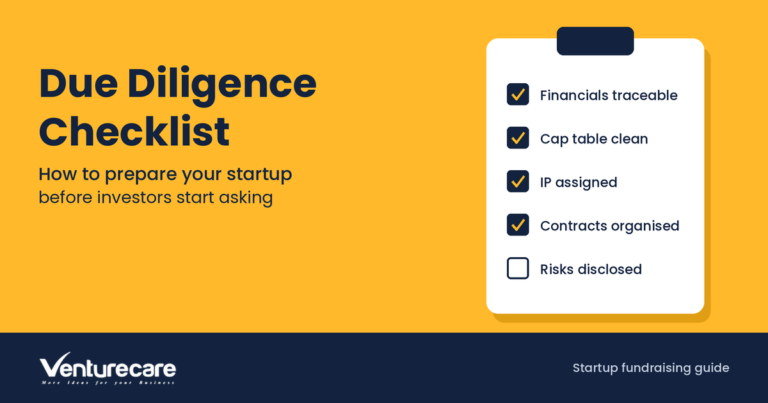
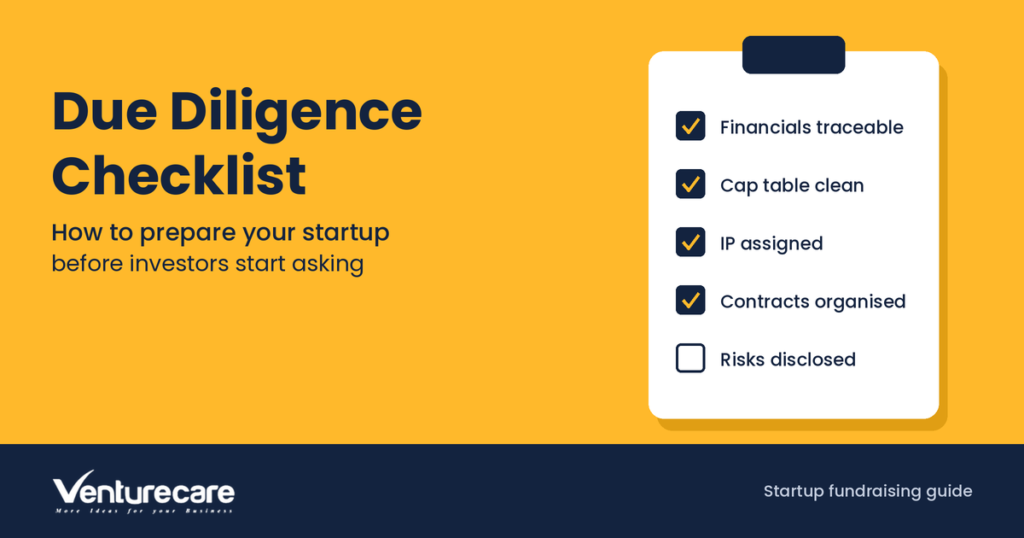
Before starting a fundraising process, founders should be able to answer “yes” to each of the following.
Corporate
- Is the company legally incorporated and compliant?
- Is the cap table accurate?
- Are previous investment documents available, and are shareholder records organised?
Financial
- Are historical financial statements available?
- Can revenue numbers be verified?
- Similarly, are projections supported by assumptions?
- Also, are taxes, liabilities and debt obligations clearly documented?
Legal
- Are customer and supplier contracts organised?
- Are founder and employee agreements complete?
- Have material disputes been disclosed, and are licences and registrations available?
Technology and IP
- Does the company clearly own its technology?
- Also, are IP assignments documented?
- Have third-party licences been recorded, and are security and data practices documented?
Commercial
- Can major revenue claims be verified?
- Are customer contracts accessible?
- Is customer concentration understood, and are retention and churn metrics consistent?
Team
- Are founder roles clearly documented?
- Are employment agreements available?
- Have key-person dependencies been identified, and can the team explain the numbers consistently?
Data Room
- Are documents logically organised?
- Also, are outdated versions clearly separated?
- Can requested information be located quickly, and is one person responsible for managing requests?
Final Thoughts: Startup Due Diligence Starts Before the Investor Arrives
Generally, due diligence is treated as something that happens after an investor becomes interested. That, however, is too late. By the time an investor starts asking detailed questions, the company should already know where its information is, which risks exist, and which areas require explanation.
Preparing for startup due diligence is therefore not just about creating a checklist. Instead, it is about building operational discipline around the business. Financial records need ownership, and legal documents need maintenance. Similarly, technology needs clear IP ownership, while customer data needs consistency. Founders also need to understand the assumptions behind their own numbers. Above all, everyone involved needs to know who is responsible for what.
Ultimately, the strongest preparation does not attempt to hide weaknesses. Instead, it identifies them early, fixes what can be fixed, documents what cannot, and gives investors enough clarity to assess the opportunity properly. As a result, good preparation reduces unnecessary surprises, shortens avoidable delays, strengthens investor confidence, and allows founders to spend less time searching for documents and more time building the company.
Getting ready for investor scrutiny?
Venture Care’s due diligence consulting team helps founders organise fundraising information, close preparation gaps and structure an investor-ready data room before the questions start.
Related reading:
- Startup Valuation 101: How to Value Your Startup
- 4 Lessons Learned from a Consultancy Due Diligence
- The Art of Pitch Deck Storytelling: Winning Investor Hearts
Frequently Asked Questions About Startup Due Diligence
What is startup due diligence?
Startup due diligence is the process investors use to verify a company’s financial, legal, commercial, technological, operational and ownership information before completing an investment.
How do I prepare my startup for due diligence?
First, organise financial, legal, corporate, commercial, team, technology, IP and compliance documents. Then make sure the information is accurate, consistent, current and easy to verify.
What documents do investors request during startup due diligence?
Investors may request financial statements, bank records, tax documents, projections, revenue information, debt records and cap table information. In addition, they may ask for legal agreements, customer contracts, employee agreements, IP records, licences and compliance documents.
How long does startup due diligence take?
The timeline varies depending on the startup’s stage, complexity, industry, transaction size, investor and quality of preparation. A straightforward process may take days or weeks, while more complex transactions can take considerably longer.
What is a due diligence data room?
A due diligence data room is a secure, organised repository containing the documents investors need to review before completing an investment. It normally contains financial, legal, corporate, commercial, team, technology, IP and compliance information.
What are the biggest startup due diligence red flags?
For example, common red flags include inconsistent financial information, an unclear cap table, missing IP ownership documents, undisclosed liabilities, unresolved legal disputes, excessive customer concentration, undocumented founder arrangements and unsupported financial projections.
Why is intellectual property important during startup due diligence?
Investors need to know that the company owns, or has appropriate rights to, the technology, trademarks, patents, software and other intellectual property that matter to the business. Consequently, missing IP assignments or unclear ownership can create significant transaction risk.
Do investors check employee and founder backgrounds?
Depending on the transaction, investors may conduct founder and management background checks. They may also review employment history, founder agreements, employee contracts, qualifications and previous businesses.
Can poor startup due diligence preparation affect valuation?
Yes. If diligence reveals material risks, inconsistencies, missing information or liabilities, investors may reconsider the proposed investment structure, valuation, investment amount or transaction terms.
When should a startup start preparing for due diligence?
Ideally, preparation should begin before a serious fundraising process starts. Building a basic data room and maintaining accurate financial, legal, ownership, commercial and IP records throughout the company’s growth makes formal investor due diligence significantly easier.
How can Venture Care help with startup due diligence?
Venture Care can support founders with investor readiness and fundraising by helping organise relevant information, identify preparation gaps, structure investor-facing materials, and create a more systematic approach to responding to investor requirements during fundraising and due diligence.