Anti-Dilution Protection: What Founders Must Know

In short: Understanding what is anti-dilution protection for founders is important before signing a term sheet, because the clause can materially affect founder ownership when a company raises future capital at a lower valuation. Anti-dilution provisions are designed to protect certain investors from the economic impact of a down round, but the protection can be structured in very different ways.
The most common approaches are weighted average anti-dilution and full ratchet anti-dilution. Their impact depends on the size of the new financing, the price of the new shares, the amount previously invested and the specific wording of the agreement. Founders therefore need to look beyond the headline valuation and understand how the provision could affect ownership across future funding scenarios.
This guide explains anti-dilution clause types, how weighted average anti-dilution works, what full ratchet anti-dilution means, how these provisions affect future funding rounds, what founders should negotiate in term sheets, and how to think about long-term dilution before agreeing to investor protection.
What Is Anti-Dilution Protection for Founders?
A startup can raise money today at one valuation and then raise money later at a lower valuation. That is known as a down round.
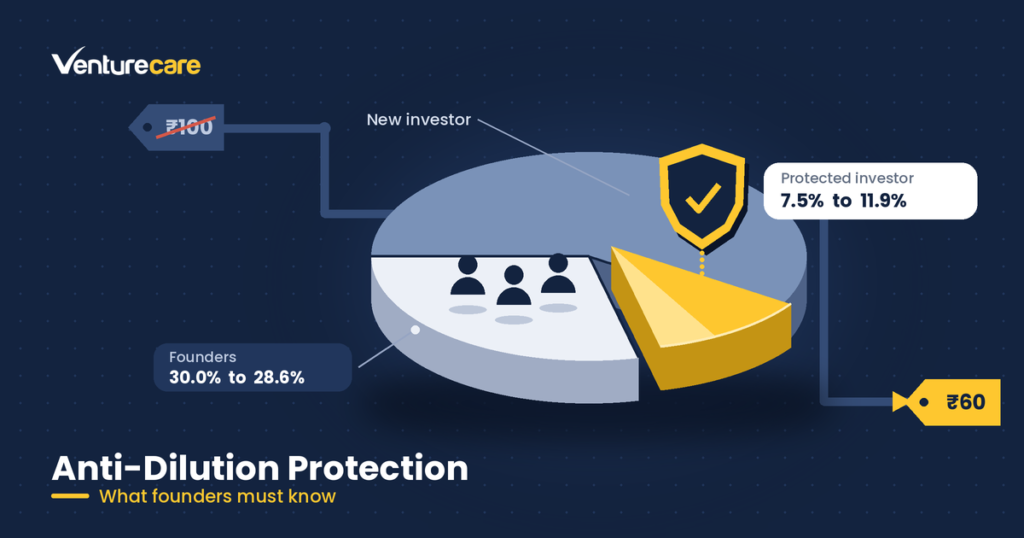
For example, suppose an investor buys preferred shares at ₹100 per share. Two years later, the company needs additional capital and can only raise money at ₹60 per share. The earlier investor has effectively invested at a higher price than the new investors. An anti-dilution provision can adjust the earlier investor’s economic position to partially or fully account for that lower share price.
This is where founders need to pay attention. Anti-dilution protection is primarily designed to protect investors, not founders. The founder’s concern is therefore different:
How much additional ownership could this protection transfer to an existing investor, and under what circumstances?
What a Good Outcome Looks Like
The tangible success state is not simply getting an investor to agree to a funding round. Instead, a successful financing structure should allow the company to raise future capital without creating an ownership structure that becomes unnecessarily difficult to manage, discourages future investors, or leaves founders with substantially less ownership than they expected. That requires understanding the clause before signing it.
Why Anti-Dilution Protection Matters to Founders
Dilution is normal in startup fundraising. When a company issues new shares to investors, existing shareholders generally own a smaller percentage of the company.
Anti-dilution protection is different. It can create an additional adjustment for a protected investor when shares are issued at a lower price in a subsequent financing. This means founders should not look only at the current valuation, current ownership and the amount being raised.
Questions to Ask Before You Sign
Founders should also ask:
- What happens if the next round is a down round?
- Which investors receive anti-dilution protection?
- What formula is used?
- Which shares are included in the calculation?
- Are there exceptions?
- Does the protection expire?
- What happens to the founder’s ownership?
- Could the clause make the next financing harder?
These questions become particularly important when a company is still early in its growth cycle and future valuations are difficult to predict.
Types of Anti-Dilution Protection Founders Will See
The two major anti-dilution clause types founders are most likely to encounter are weighted average anti-dilution and full ratchet anti-dilution. They do not have the same economic effect.

Weighted Average Anti-Dilution
Weighted average protection adjusts the investor’s conversion price based on both the old share price and the size of the new financing. The basic idea is straightforward: a small down round should generally have a smaller impact than a large down round.
If a company previously issued a large number of shares at a higher price and then issues a relatively small number of shares at a lower price, the adjustment is limited. On the other hand, if the company issues a very large number of new shares at the lower price, the adjustment becomes more significant.
This is generally less severe for founders than a full ratchet, because the investor does not automatically receive an adjustment all the way down to the new share price.
The Weighted Average Formula
The standard formula is short. Cooley GO’s guide to down rounds sets it out as:
CP2 = CP1 × (A + B) ÷ (A + C)
- CP1 is the investor’s conversion price before the new round, and CP2 is the adjusted price after it.
- A is the number of shares counted as outstanding before the round. This is where “broad-based” and “narrow-based” differ.
- B is the number of shares the new money would have bought at the old price.
- C is the number of shares actually issued in the new round.
A lower CP2 means each preferred share converts into more common shares. For an Indian law-firm perspective on the same arithmetic, see Nishith Desai Associates’ note on cracking the anti-dilution formula.
Broad-Based Weighted Average
A broad-based weighted average formula generally considers a wider pool of the company’s existing shares when calculating the adjustment. Depending on the agreement, the calculation may include common shares and certain outstanding securities that could convert into shares.
The broader the denominator, the more moderate the adjustment can generally become. The exact formula matters, however. Founders should not assume that “weighted average” automatically means the same thing in every term sheet.
Narrow-Based Weighted Average
A narrow-based weighted average uses a smaller pool of shares in its calculation. Because fewer shares are included, the resulting adjustment can be more significant than under a broad-based formula.
This is why simply seeing the words “weighted average” in a term sheet is not enough. The actual definition of the capitalization base needs to be reviewed.
Full Ratchet Anti-Dilution
Full ratchet is much more aggressive. Under a full ratchet provision, if new shares are issued at a lower price than the price paid by the protected investor, the investor’s conversion price can be adjusted to the new lower price. For example, an investor originally invests at ₹100 per share. The company later issues shares at ₹60 per share. Under a full ratchet provision, the investor’s conversion price could be adjusted from ₹100 to ₹60.
The investor does not necessarily receive cash back. Instead, the conversion mechanics can allow the investor to receive more shares when their preferred shares convert into common shares.
That additional ownership comes from somewhere. In practical terms, it can increase dilution for founders and other shareholders. This is why full ratchet anti-dilution provisions deserve particularly careful attention during negotiations.
How Common Is Full Ratchet?
In mainstream venture deals, full ratchet is now rare. In Cooley’s Q3 2024 venture financing report, every reported deal used broad-based weighted average protection and none used full ratchet. That data covers US deals, so terms in other markets and with other investor types can differ. Even so, if a term sheet asks for full ratchet, it is fair to ask why.
A Simple Example of How Anti-Dilution Can Change Ownership
Imagine a startup has 1,000,000 shares outstanding. An investor purchases 200,000 shares at ₹100 each.
The company later struggles to hit its expected milestones and needs another ₹10 crore. The new investor is willing to invest only at ₹60 per share, so the company issues new shares at a substantially lower price.
Without anti-dilution protection, the original investor continues to own the number of shares originally purchased, subject to the ordinary dilution caused by the new financing. With anti-dilution protection, the original investor may receive an adjustment depending on the clause:
- Under a weighted average provision, the adjustment depends on the size of the new financing relative to the existing capitalization.
- Under full ratchet, the adjustment can be much more substantial, because the earlier conversion price can move directly to the lower issuance price.
Same Down Round, Four Outcomes
Here is how the example could play out. The table assumes the 1,000,000 shares include the investor’s 200,000 and founders hold the other 800,000. It also assumes there is no option pool, and the new investor’s 1,666,667 shares stay fixed. For the narrow-based case, the base counts only the investor’s own series.
| Clause | New conversion price | Investor’s shares | Investor ownership | Founder ownership |
|---|---|---|---|---|
| No protection | ₹100 | 200,000 | 7.5% | 30.0% |
| Broad-based weighted average | ₹75 | 266,667 | 9.8% | 29.3% |
| Narrow-based weighted average | ₹64.29 | 311,111 | 11.2% | 28.8% |
| Full ratchet | ₹60 | 333,333 | 11.9% | 28.6% |

In this case, the founders lose 1.4 more percentage points under full ratchet than with no protection. Meanwhile, the protected investor’s stake rises by more than half, from 7.5% to 11.9%. Every extra share the investor gains comes out of the other holders’ percentages.
The important lesson is not the exact number of shares in this example. It is that the same down round can produce very different ownership outcomes depending on the anti-dilution formula. Founders should therefore model the clause rather than simply reading its title.
How Weighted Average Protection Protects Investors
Weighted average protection tries to balance two interests. The investor wants protection against a significant decline in the company’s valuation. The founder and other shareholders, by contrast, do not want an earlier investor to receive an excessive ownership adjustment because of a relatively small financing.
Why the Size of the Down Round Matters
The formula accounts for the amount of new money being raised, and this creates an important practical distinction. Suppose a company previously raised ₹50 crore at a high valuation but later raises only ₹2 crore at a lower valuation. The new round represents a relatively small financing compared with the existing capital base. As a result, a weighted average mechanism generally produces a more limited adjustment than full ratchet protection.
But if the company raises a very large amount at a much lower price, the effect can become more significant. This is why the size of the down round matters.

What Founders Should Negotiate in Term Sheet Anti-Dilution Provisions
Founders should not treat anti-dilution protection as a simple yes-or-no issue. The real negotiation is about the details.
1. Negotiate the Formula
Understand whether the clause uses broad-based weighted average, narrow-based weighted average, full ratchet or another negotiated mechanism. The NVCA model legal documents, which many US venture deals use as a starting point, are a useful reference for standard wording.
Ask the investor to show how the formula works under an actual down-round scenario. If nobody can explain the outcome clearly, the provision is not ready to be signed.
2. Define What Counts as a New Issuance
Not every share issuance should necessarily trigger anti-dilution protection. A company may issue shares or options for legitimate reasons unrelated to fundraising, for example:
- Employee stock options
- Strategic partnerships
- Acquisitions
- Certain convertible securities
- Shares issued under existing commitments
The term sheet and definitive agreements should clearly identify which issuances trigger the provision.
3. Negotiate the Exceptions
Anti-dilution clauses commonly contain exceptions or exclusions. Founders should understand these rather than accepting a generic list.
For instance, an exclusion might cover shares issued under an employee option plan or securities already contemplated by an existing financing arrangement. The exact wording matters, because poorly defined exceptions can create disputes later.
4. Consider a Floor or Sunset
Founders can negotiate limitations on how long anti-dilution protection remains active or under what circumstances it applies. For example, the parties may negotiate a sunset after a specified financing event or period.
Whether an investor accepts such a provision depends on the transaction, but it is worth discussing before the definitive documents are signed. Even after signing, the protection is not always final. Cooley notes that founders regularly negotiate with investors to waive or reduce an adjustment when the next round arrives.
How Anti-Dilution Protection Affects Founders in Future Funding Rounds
One of the biggest mistakes founders make is evaluating an anti-dilution clause only against today’s cap table. The clause needs to be tested against tomorrow’s financing. Consider three possible scenarios.
Scenario 1: The Next Round Is Higher
The company raises money at a higher valuation. Anti-dilution protection may not be triggered.
Scenario 2: The Next Round Is Slightly Lower
The company raises money at a modestly lower valuation. A weighted average adjustment may apply, depending on the terms.
Scenario 3: The Next Round Is Substantially Lower
The company experiences a significant setback and raises capital at a much lower valuation. Here, the anti-dilution adjustment can become much more consequential.
The third scenario is particularly important. Founders should model it before signing the original investment agreement.
Long-Term Dilution Scenarios Founders Should Model
A good cap table model should not stop at the current round. Build scenarios for:
- Next round at a higher valuation
- Next round at the same valuation
- Moderate down round
- Significant down round
- Large emergency financing
- Multiple future rounds
Then compare founder ownership under each scenario. This is where financial modelling becomes useful.
The question is not “Does this clause look reasonable?” The better question is:
“If our company raises ₹20 crore two years from now at a 40% lower valuation, what happens to every major shareholder?”
That produces an answer that founders can actually use.
Common Mistakes Founders Make With Anti-Dilution
Treating All Anti-Dilution Clauses as the Same
They are not. The formula, definitions, exclusions and trigger conditions can materially change the outcome.
Negotiating Only the Valuation
Founders sometimes spend significant time negotiating whether the investor enters at ₹20 crore or ₹25 crore while overlooking the rights attached to the shares. A slightly higher valuation does not necessarily compensate for an unusually aggressive set of investor protections.
Ignoring the Next Round
The clause needs to be evaluated against future financing scenarios, not just the current transaction.
Not Understanding the Cap Table
If the founders do not understand their own capitalization table, they will struggle to understand how anti-dilution protection affects them.
Assuming the Lawyer Will Handle Everything
Legal counsel is essential for reviewing definitive agreements, but founders need to understand the commercial consequences themselves. After all, the founder is ultimately responsible for understanding what ownership they are giving up and what rights they are granting.
Protecting Founder Equity: Look at the Whole Term Sheet
The founder’s ownership percentage is only one part of the equation. Founders also need to consider control, voting rights, liquidation preferences, option pools, future fundraising and other investor rights.
A founder could negotiate a higher headline valuation while simultaneously agreeing to terms that create significant economic consequences in later rounds. This is why a term sheet should be viewed as a complete economic package. The question should not simply be “What valuation are we getting?” It should be:
“What ownership and rights are we giving away, under both the expected scenario and the difficult scenarios?”
The Role of Venture Care in Anti-Dilution and Fundraising
Anti-dilution provisions sit at the intersection of fundraising strategy, financial modelling, investor negotiations and long-term ownership planning. This is where Venture Care’s role can be relevant to founders.
Venture Care can help founders prepare for fundraising by helping them understand the commercial implications of proposed investment terms, organize their fundraising information, review ownership scenarios, and model how different financing structures may affect the company’s future capitalization.
The important part is not simply identifying that a term sheet contains an anti-dilution clause. A founder needs to understand what that clause could mean two or three funding rounds later. For example, Venture Care can help founders compare scenarios such as:
Current round → future up round → future down round → founder ownership
against
Current round → future down round → anti-dilution adjustment → revised ownership
That gives founders a more practical basis for discussion with investors and legal advisors.
Venture Care’s role is therefore not to replace legal counsel. The final wording of an anti-dilution provision should be reviewed by qualified legal professionals. Its value is in helping founders approach the commercial and fundraising side of the discussion with clearer numbers, better scenarios, and a stronger understanding of what the proposed terms mean for the company’s longer-term financing strategy.
How Founders Should Approach an Anti-Dilution Protection Negotiation
A practical negotiation can follow five steps.

Step 1: Understand the Investor’s Concern
Ask why the investor wants anti-dilution protection. An investor entering at a high valuation may be concerned about paying substantially more per share than future investors. Understanding the concern can make it easier to negotiate a reasonable mechanism.
Step 2: Model the Down Round
Do not negotiate in abstract terms. Put actual numbers into the cap table. For example, model a 10%, 25%, 40% and 50% reduction in the next round’s valuation, then see what happens under different formulas.
Step 3: Compare the Structures
Compare broad-based weighted average, narrow-based weighted average and full ratchet treatment where relevant. Look at the impact on:
- Founder ownership
- Existing investor ownership
- New investor ownership
- Option pool
- Future fundraising
Step 4: Clarify Trigger Events and Exceptions
Make sure everyone understands which future issuances trigger the clause and which do not. Ambiguity becomes expensive when a company is already under pressure to raise money.
Step 5: Get Legal Review
The commercial model tells you what the clause does economically. Legal counsel should then assess the actual contractual language and whether the rights, definitions, exceptions and mechanics accurately reflect the negotiated agreement.
Final Thoughts on Anti-Dilution Protection for Founders
Anti-dilution protection is not inherently good or bad for a startup. It is an investor protection mechanism whose consequences depend on how it is structured.
For founders, the real issue is understanding the trade-off. An investor may be willing to invest today because they receive protection against a future down round. The founder, meanwhile, needs to make sure that protection does not create disproportionate ownership consequences or make future fundraising unnecessarily complicated.
That is why understanding what is anti-dilution protection for founders requires looking beyond the terminology:
- Know the formula.
- Understand the trigger.
- Check the exclusions.
- Model the down round.
- Look at the impact on founder ownership.
- Then consider how the provision interacts with the company’s next financing.
The strongest fundraising decisions are rarely made by looking at one term in isolation. Valuation, dilution, liquidation preferences, voting rights, investor protections and future financing requirements all interact.
For founders, the objective should be a financing structure that gives the company enough capital to execute while keeping the ownership and governance structure workable for the long term. And when the numbers become complicated, get both sides of the equation right: use financial and fundraising analysis to understand the commercial impact, and qualified legal counsel to review the actual contractual protection.
Reviewing a term sheet with anti-dilution terms?
Venture Care’s financial modelling team can model your cap table under up, flat and down rounds, so you can see what each formula does to your ownership before you sign.
Related reading:
- Seed Funding for Startups: A Complete Beginner’s Guide
- Effective Investor Communication Strategies for Building Lasting Relationships
Frequently Asked Questions About Anti-Dilution Protection
What is anti-dilution protection for founders?
Anti-dilution protection is a contractual provision that protects certain investors when a company issues shares in a future financing at a lower price than the price they previously paid. Depending on the structure, it can adjust the investor’s conversion price and increase the number of shares they can receive.
What are the main types of anti-dilution protection?
The main anti-dilution clause types are weighted average anti-dilution and full ratchet anti-dilution. Weighted average provisions adjust the investor’s conversion price based on the size and price of the new financing. Full ratchet provisions, by contrast, can adjust the conversion price directly to the lower price of the new financing.
What is weighted average anti-dilution?
Weighted average anti-dilution adjusts the conversion price using a formula that considers the previous share price, the new issue price and the amount of new securities being issued. Broad-based and narrow-based weighted average provisions can produce different results.
What is full ratchet anti-dilution?
Full ratchet anti-dilution can reduce an existing investor’s conversion price to the price paid in a subsequent lower-priced financing. This can result in a larger increase in the investor’s share entitlement than a weighted average formula, and can create greater dilution for founders and other shareholders.
Does anti-dilution protection apply to every future funding round?
Not necessarily. Anti-dilution provisions generally specify the circumstances in which they are triggered and may contain exceptions for certain types of share issuances. The exact contractual language determines how the provision operates.
How does anti-dilution protection affect founder equity?
Anti-dilution protection can affect founder equity because an adjustment may increase the number of shares an existing investor can receive upon conversion. This can reduce the founder’s percentage ownership, particularly under more aggressive protection mechanisms.
What should founders negotiate in an anti-dilution clause?
Founders should understand and negotiate the formula, the capitalization base, trigger events, exclusions, duration of protection and treatment of future financing instruments. They should also model the effect of the clause under different future fundraising scenarios.
Is weighted average anti-dilution better for founders than full ratchet?
The economic effect differs between the two structures. Weighted average protection generally considers both the size of the new financing and the new share price, while full ratchet can adjust directly to the new lower price. Founders should compare the actual ownership outcomes under their specific cap table rather than relying only on the name of the provision.
Can anti-dilution protection affect future fundraising?
Yes. Depending on the terms, anti-dilution provisions can affect the economics of future financing rounds. Potential investors may examine existing investor rights before committing capital, particularly when the company is raising at a lower valuation.
Should founders accept anti-dilution protection?
The answer depends on the financing terms as a whole. Founders should understand the investor’s requested protection, model its effect under different future scenarios, compare alternative structures, and have qualified legal counsel review the final provision before signing.
How can Venture Care help with anti-dilution and fundraising?
Venture Care can help founders understand the fundraising and commercial implications of proposed investment terms, organize ownership information, model future dilution scenarios and prepare for investor negotiations. Legal counsel should review and advise on the final contractual language of an anti-dilution provision.