The Art of Pitch Deck Storytelling: Winning Investor Hearts

Pitch deck storytelling is what turns a set of slides into an investment case. Here is how founders can build one that holds up when an investor reads it alone.
A strong pitch deck does not succeed because it contains all the expected slides or because it makes an investor feel excited for twenty minutes. It succeeds when an investor can understand, without the founder sitting beside them, why the opportunity exists now, who has the problem, why the problem is painful enough to create buying behaviour, what the product actually changes, what customers have already proven, how that value becomes a scalable business, why this team can execute, and what additional capital will accomplish. This is the real meaning of how to tell a compelling story in your pitch deck. The best pitch deck storytelling connects evidence into a causal argument rather than presenting disconnected information.
The Real Success State of a Pitch Deck
Most advice about pitch decks starts with the slides. Start with the problem. Explain the solution. Show the market. Introduce the competition. Present traction. Talk about the team. Show the financials. End with the funding ask.
It is a familiar structure because these are all things investors need to understand. But there is a problem: a founder can include every expected section and still produce a weak investment story.
The deck may say the market is large, the product is innovative, customers are growing, the founders are experienced and the company is raising ₹5 crore. Yet an investor can finish the presentation thinking:
I understand what this company does. I am still not sure how all these facts connect.
That is the real problem with template-driven pitch decks. A pitch deck is not successful because it is complete. It is successful when it creates a clear understanding of how the business works and why the next stage of growth is plausible.
What an Investor Should Be Able to Answer
After reading the deck, an investor should be able to answer a set of practical questions:
- Why does this opportunity exist now and not five years ago?
- Who specifically suffers from the problem?
- Is the pain serious enough for someone to change behaviour or spend money?
- What does the product actually do differently?
- Has that intervention produced a measurable result?
- Can that result become a repeatable commercial model?
- Why can the business become large?
- Why is this team particularly suited to execute it?
- What remains unproven?
- And what exactly will the proposed capital change?
That is the tangible success state.
Pitch Deck Storytelling Means Connecting Reasons to Believe
Storytelling in fundraising is therefore not about dramatic openings, emotional speeches or clever phrases. It is about reducing the amount of mental work an investor has to do to understand the investment case. Think of storytelling as creating a sequence of “reasons to believe” rather than simply presenting information, and those reasons need to be connected causally.
A market trend by itself proves very little. On its own, a customer story proves very little too. The same is true of a product demo, and even a revenue number says little in isolation. Instead, the value comes from connecting them.
That is a story an investor can evaluate.
Why Investors Invest in Founders First
The phrase “investors invest in founders first” is repeated frequently, but it is often misunderstood. It does not mean that a founder should spend two slides listing degrees, previous employers and impressive job titles.
Early-stage companies simply do not have enough historical evidence for investors to evaluate the business entirely through financial performance. The team becomes part of the evidence.
The useful question is therefore not “How impressive are these founders?” It is “Why are these founders unusually relevant to this problem?”
Founder-Market Fit as Narrative
Consider a founder who spent eight years managing logistics operations. That fact is mildly interesting.
Now suppose that during those eight years, the founder repeatedly encountered a scheduling problem, built an internal tool to solve it, discovered that other operators were experiencing the same issue, and then turned that internal solution into a product. Now the experience has a job in the story.
- The experience explains the insight.
- The insight explains the product.
- The product explains the company.
That is founder-market fit expressed through narrative.
The same applies to the wider team. An investor does not necessarily need to know every achievement. They need to understand why the combination of skills matters. A technical founder may understand the underlying technology. A commercial founder may understand distribution. An industry operator may understand customer behaviour and procurement. Those capabilities become more meaningful when they connect directly to the company’s execution requirements.
Separate Evidence from Assumption
There is another human factor founders should acknowledge. Founders are naturally optimistic. They have to be. Building a company requires sustained belief before the market has fully validated the idea. But optimism can also blur the distinction between evidence and assumption.
A credible pitch makes the distinction explicit:
- What do we know?
- What have we tested?
- What do we believe?
If 40 customers have validated the problem but only five are paying, that is different from saying the market is validated. Similarly, if customers are renewing but acquisition costs are still high, that is a different business problem from weak retention. And when one acquisition channel works well but has not yet scaled, that is promising evidence, not proof of a scalable distribution engine.
Strong founders do not hide these distinctions. They understand them. That is part of what investors are evaluating when they assess the team.
Building a Narrative Arc That Converts
A useful pitch deck narrative structure is built around causality rather than slide order. The conventional structure says: Problem. Solution. Market. Competition. Traction. Team. Financials. Ask.
A stronger structure asks what each piece is supposed to establish:
- Why does the opportunity exist?
- Who is experiencing the problem?
- What is the operational friction?
- What intervention changes it?
- What evidence proves that the intervention works?
- How does that value become revenue?
- What prevents competitors from simply copying the approach?
- What constraint is stopping the business from reaching the next stage?
- What will capital do about that constraint?
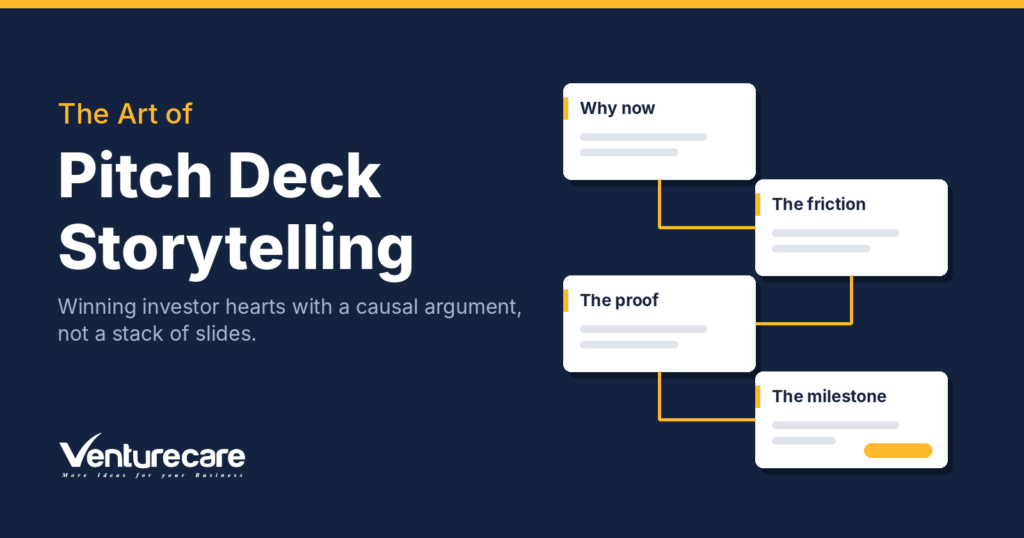
This creates a causal chain:

The sequence can vary by company. For example, a deep-tech business may need more technical validation. A biotech company, on the other hand, may need regulatory or scientific evidence, while a marketplace may need to explain supply and demand dynamics.
The principle of pitch deck storytelling stays the same. Every slide should make the next conclusion easier to reach.
The Slide Logic Matrix
The following matrix turns that principle into an operational reference. The important distinction is between a descriptive statement, which tells an investor what exists, and a causal statement, which explains what is happening, why it matters and what it produces.
| Slide Goal | Common Mistake: Descriptive | Strategic Narrative: Causal | Critical Diligence Question Answered |
|---|---|---|---|
| 1. Macro Trigger | “The compliance market is growing at 18% CAGR.” | “Regulatory updates have doubled review hours for mid-tier banks since 2024.” | Why does this opportunity exist today and not five years ago? |
| 2. Customer Friction | “SMEs waste time on manual financial tasks.” | “Finance leads spend 15 hours per week reconciling invoices across disjointed ERPs.” | Who specifically suffers acute, budget-holding pain? |
| 3. The Mechanism | “We are an AI workflow automation engine.” | “We auto-reconcile clean records and route only exceptions to human review.” | What is the actual operational intervention? |
| 4. Proof of Value | “Users love our platform and leave great reviews.” | “Early deployments reduced reconciliation cycle time from 48 hours to 90 minutes.” | Does the product produce quantifiable operational ROI? |
| 5. Business Engine | “Multiple SaaS monetization channels available.” | “₹50,000 per seat per year; CAC recovered in five months through direct accounting-firm referrals.” | How does delivering value turn into predictable gross margin? |
| 6. Capital Milestone | “Raising ₹8 crore for product and marketing.” | “Raising ₹8 crore to fund 10 sales representatives and cross the ₹20 crore ARR inflection point.” | What concrete risk or commercial bottleneck does this money retire? |
Every Slide Needs an Investor Question
The point is not that every startup should have exactly six slides. The point is that every slide should have an investor question behind it.
- If the market slide only says the category is growing, the investor still needs to understand why that growth creates an opportunity for this company.
- If the problem slide says businesses waste time, the investor needs to know who experiences the pain, whether they control a budget, and whether the pain is severe enough to change behaviour.
- If the solution slide says “AI-powered automation”, the investor needs to understand what actually happens differently.
- If the traction slide shows user numbers, the investor needs to understand what those users prove.
- If the business model shows five possible revenue streams, the investor needs to know which one is actually working.
- If the funding slide allocates money to departments, the investor needs to understand what commercial or operational constraint that money removes.
That is why the most useful question when building a pitch deck is not “What slide comes next?” It is:
What uncertainty should this slide reduce?
That single question can expose weaknesses before the investor does.
The Problem-Solution-Impact Framework
One of the most useful pitch deck storytelling frameworks for startups is Problem-Solution-Impact. Its value is not that it is a universal template. Its value is that it forces the founder to establish a relationship between customer pain, product intervention and measurable outcome.

Start with the problem
❌ Avoid
“Businesses lose billions every year because of inefficient workflows.”
It may sound significant, but it is too broad. Who is losing the money? How often? Doing what? Why has the existing process survived? What makes the problem urgent now?
✅ Stronger
“A finance manager at a 500-person company can spend 10 to 15 hours every week reconciling invoices across different systems.”
Now there is a person, a task, a frequency and a cost.
Then explain the solution
Do not immediately list fifteen features. Explain the intervention.
“Our platform connects those systems, automatically reconciles invoices and sends only exceptions to the finance team.”
Now the investor understands what the product changes.
Then show the impact
“Customers using the platform have reduced manual reconciliation time by 70%.”
That final piece is critical. The product is no longer simply a piece of technology. It has produced an outcome.
But there is a deeper point. The chain has to survive operational reality.
- A painful problem does not automatically produce sales.
- A useful product does not automatically produce retention.
- Strong retention does not automatically produce profitable growth.
- Revenue does not automatically mean a scalable business.
Each step needs its own evidence. That is why the Problem-Solution-Impact framework should be treated as the beginning of the business argument, not the entire argument.
Data Storytelling Best Practices
Data is often treated as the analytical part of the pitch, separate from storytelling. That is a mistake, because good pitch deck storytelling depends on it. Numbers are part of the story because they tell the investor whether the claims being made are supported by evidence.
❌ Less informative
₹4.2 crore revenue
✅ More informative
₹4.2 crore ARR, growing 92% year over year, with 78% gross margin.
The second statement provides more information about the shape of the business. But even that number needs context. Was the growth broad-based? Did one large customer create most of it? Is retention improving? Are margins stable? Are customers expanding their spending?
The same applies to customer counts. “250 customers” is much less informative than “250 paying customers, with 42% of new customers coming through referrals.” The second metric begins to say something about customer behaviour and acquisition.
This is the essence of effective data storytelling best practices:
- Start with the claim.
- Then identify the uncertainty behind it.
- Then choose the evidence that most directly reduces that uncertainty.
If the claim is that customers love the product, registrations are weak evidence. Retention, repeat usage, expansion or referrals may be stronger. If the claim is that customer acquisition can scale, CAC, payback period and channel performance become relevant. If the claim is that the company has attractive economics, gross margin, contribution margin and customer-level economics may matter.
Every metric should have a job.
Do Not Make the Data Prove Too Much
There is another important rule: do not make the data prove more than it actually proves.
- Ten thousand signups do not automatically prove product-market fit.
- Rapid revenue growth does not automatically prove efficient growth.
- A large TAM does not prove customers will buy.
- A positive customer testimonial does not prove repeatable demand.
Credibility often increases when founders are precise about the boundary of their evidence.
How to Balance Data and Emotion in Pitches
The question of how to balance data and emotion in pitches is often framed as though founders have to choose between the two. They do not.
Emotion creates context. Data creates confidence.
The strongest presentations use one to strengthen the other.
Imagine a startup serving independent retailers. A founder might tell the story of a shop owner spending Sunday evenings reconciling inventory across three systems. That gives the investor a human situation. But it does not establish market scale.
The next step might show how inventory errors tie up working capital, create stock-outs and reduce sales across thousands of retailers. Then the product shows how the workflow changes. Then customer data shows whether the change is real.

This is also where creating emotional connection in presentations becomes useful. Specificity is usually more powerful than exaggeration. For instance, a real customer experience can make an abstract problem tangible. Likewise, a founder’s personal experience can explain why they recognised the problem earlier than others, and a customer story can make an operational inefficiency understandable.
But emotion should serve the business argument. If the story makes people feel something but does not help them understand customer behaviour, urgency, founder-market fit or economic impact, it is probably not doing enough work.
The goal is not to make investors emotional. The goal is to make the problem matter enough that they want to examine the evidence.
Competitive Differentiation Is More Than a Competitor Matrix
Competition slides often become one of the weakest parts of a pitch. Founders list competitors, add check marks under features, and declare themselves “faster, cheaper and better.” The problem is that competitors can make the same claim.
A stronger competitive narrative answers: why can this company continue winning when other companies respond?
That advantage might come from proprietary data, distribution, customer relationships, switching costs, network effects, specialised technology, regulatory knowledge, brand, or deep industry expertise. But a claimed moat is not automatically a moat.
- If the advantage is proprietary data, explain where the data comes from and why competitors cannot easily reproduce it.
- If the advantage is distribution, explain how customers are reached and why that channel can scale.
- If the advantage is switching cost, explain what becomes difficult to replace.
- If the advantage is a network effect, show evidence that the product actually becomes more valuable as adoption increases.
This is where real-world friction matters. Competitors respond. Customers negotiate. Sales channels become saturated. Employees leave. Acquisition costs rise. Regulation changes.
A competitive advantage that only exists when nobody reacts is not much of an advantage. The deck should therefore show not just why the company can win today, but why its advantage can strengthen as the company grows.
Common Pitch Deck Storytelling Mistakes Founders Make
1. Starting with the product
Founders naturally want investors to see what they have built. But without context, a dashboard or product screenshot may not mean much. The investor has not yet been given a reason to care.
2. Using adjectives instead of evidence
“Revolutionary”, “disruptive”, “next-generation” and “game-changing” do not establish credibility. Retention does. Revenue does. Usage does. Measurable customer outcomes do.
3. Telling different stories in different parts of the deck
If the customer slide says the business targets small companies but the financial model depends on enterprise contracts, there is a fundamental inconsistency. The product, customer, go-to-market strategy, market sizing and financial model should describe the same underlying business.
4. Confusing complexity with sophistication
A deck containing thirty metrics, seven market charts and multiple product screenshots may look comprehensive while making the company harder to understand. The question should not be “How much information can we fit?” It should be “What does the investor need to understand here?”
5. Hiding uncertainty
Early-stage companies have assumptions. That is normal. Pretending everything is already proven can make a founder less credible. A statement such as:
“We have validated the problem with 40 customers, but we have not yet proven that our acquisition model scales efficiently beyond this segment.”
is useful because it tells the investor where the business still needs to learn.
6. Making the funding request too generic
“Raising ₹5 crore for sales, marketing and hiring” describes spending. It does not explain the business outcome. The more useful question is: what constraint does the money remove?
If demand is proven but distribution is limiting growth, the capital should address distribution. When the product works but requires development before entering a larger segment, the milestones should reflect that. However, if the company has strong retention but weak acquisition economics, simply spending more on customer acquisition may increase the problem.
Capital allocation is therefore part of the story.
Case Studies of Successful Pitch Narratives
Studying pitch deck storytelling examples is useful because successful decks demonstrate how founders can make unfamiliar businesses understandable.
Airbnb: Make the Unfamiliar Familiar
Airbnb’s early pitch deck is widely studied because it made an unfamiliar behaviour easier to understand through familiar problems. Travellers needed accommodation. Hosts had unused space. The proposition connected those two behaviours.
The important lesson is not that founders should copy Airbnb’s wording or slide design. It is that when the business model is unfamiliar, the founder should anchor it in behaviour the investor already understands. Airbnb’s early story connected travellers and hosts to concrete problems around accommodation, price and the travel experience.
Uber: Start With a Credible Wedge
Uber’s original UberCab deck also provides a useful lesson. It did not present the enormous global ride-hailing company it eventually became. It described a narrower proposition involving urban professionals, smartphones, GPS, digital dispatch and cashless payment.
That matters because founders often make the opposite mistake. They attempt to present the company they hope to become ten years from now. An investor may instead need to understand: what is the initial wedge, why does it work, and why can it expand?
The early Uber story established a starting point and a mechanism for expansion rather than requiring investors to believe the entire future in advance.
Loom: Let the Product Prove the Product
Loom provides a useful lesson for product-led businesses. When the product itself is visual or experiential, explaining it through paragraphs may be less effective than demonstrating it.
- If the product saves time, show the before and after.
- If it automates a process, demonstrate the workflow.
- If it creates a different user experience, let the investor experience that difference.
The product demonstration should not interrupt the story. It should be evidence within the story.
Across all three examples, the common principle is not presentation design. It is evidence. Make the unfamiliar understandable. Make the starting point credible. And whenever possible, let the product or customer behaviour prove the claim instead of simply describing it.
The Final Slide Should Complete the Story
The final slide should answer one practical question: what happens if you give us this money?
❌ Weak
“We are raising ₹10 crore for sales, marketing and product development.”
✅ Strong
“We are raising ₹10 crore to expand from 120 to 500 enterprise customers, launch two additional product modules and reach ₹25 crore ARR over the next 24 months.”
The second statement connects capital to milestones. But the important point is that the final slide cannot manufacture this logic. The entire deck should prepare for it.
If customer demand is proven but distribution is the constraint, the capital should address distribution. When the product works but additional development is needed before expansion, the milestones should reflect that. And if the company has strong retention but acquisition costs are too high, the funding plan should explain how that economic constraint will be addressed.
This is why “use of funds” should not simply mean dividing money between departments.
Capital should have a job.
The investor should understand what risk, constraint or bottleneck the funding is intended to remove. That makes the funding ask part of the narrative rather than a final request for permission to spend money.
The Storyboard Test: Read Only the Headlines
There is a simple pitch deck storytelling test founders can perform before sending the deck. Ignore every image, every chart and every bullet. Then read only the slide headlines and ask: does the deck still tell a story?

The second version does not necessarily contain more information. It contains more meaning. The headlines tell the investor what to conclude. This is one of the easiest ways to identify a deck that is still too descriptive.
If the investor has to remember something from Slide 3 to understand Slide 9, the causal connection may not be clear enough. The goal is not to make every slide self-contained. The goal is to make the sequence cumulative. Each slide should make the next one easier to understand.
How to Tell a Compelling Story in Your Pitch Deck
Before opening PowerPoint, Keynote or Figma, write the business argument in plain language.
- Start with the macro trigger. What changed?
- Define the customer friction. Who suffers? What do they currently do? What does the problem cost? Who controls the budget?
- Explain the mechanism. What actually happens when the customer uses your product?
- Show proof of value. What measurable result has already occurred?
- Explain the business engine. Who pays? How much? How are customers acquired? What does acquisition cost? How quickly is it recovered? What happens to margins as the business grows?
- Explain the execution advantage. Why can this team solve the problem better than alternatives?
- Identify the next constraint. What is preventing the business from reaching the next meaningful milestone? That is where the capital comes in.
This process produces a much stronger foundation for how to tell a compelling story in your pitch deck than beginning with slide design.
Once the argument works, give every slide one job. Use a customer story where human context matters and data where evidence matters. Similarly, use a product demonstration where the product itself is the proof, and financials where economics matter. Remove information that does not strengthen the conclusion.
And keep asking: What should the investor believe after seeing this slide? Then ask one question more: What evidence makes that belief reasonable?
That second question is what separates pitch deck storytelling from decoration.
Final Takeaway on Pitch Deck Storytelling
The art of pitch deck storytelling is not about making investors emotional. It is about making the business understandable, testable and commercially credible.
A strong deck creates a chain of reasoning:
- The market has changed.
- That change creates meaningful customer friction.
- The company has built a mechanism to address it.
- Customers are responding to that mechanism.
- The response creates measurable value.
- That value can become a business engine.
- The team has a credible reason to execute.
- The advantage can survive real-world competition.
- And the capital has a specific job.
That is what good storytelling does. It does not guarantee investment, hide uncertainty or turn assumptions into facts. Instead, it simply makes the logic of the opportunity easier to evaluate.
The strongest pitch decks do not force investors to assemble the argument themselves. Instead, they show the mechanism and the evidence. They also show where the business is still uncertain, and why the next amount of capital is connected to a meaningful change in the company’s trajectory.
The presentation then stops being a collection of slides. It becomes an explanation of how the business works.
Want a second pair of eyes on your deck’s story?
Venture Care’s pitch deck team helps founders turn their slides into an argument investors can evaluate.
Related reading:
- Effective Investor Communication Strategies for Building Lasting Relationships
- India Startup Funding Landscape Q1 2026
Frequently Asked Questions
How do you tell a compelling story in a pitch deck?
Start by defining what you need the investor to understand, then build a causal sequence from the market trigger to customer friction, product mechanism, proof of value, business engine and capital milestone. Each slide should answer an important investor question rather than simply present another category of information.
What is a good pitch deck narrative structure?
A strong pitch deck narrative structure connects the reason the opportunity exists, the specific customer problem, the product mechanism, evidence of customer value, the business model, competitive advantage, team capability and funding requirement. The exact number and order of slides can vary by company.
What are useful storytelling frameworks for startups?
The Problem-Solution-Impact framework is useful for connecting customer pain to product intervention and measurable outcome. A broader framework can connect that sequence to business economics, competitive differentiation, execution capability and capital requirements.
How do you balance data and emotion in pitches?
Use emotion to make the customer problem understandable and data to establish whether the problem and solution have commercial significance. A specific customer experience can create context, while retention, revenue, usage, margins, CAC or other relevant metrics can provide evidence.
What are the best data storytelling practices for pitch decks?
Start with the claim you want the investor to understand. Identify the uncertainty behind that claim and select the metric that most directly reduces it. Give the metric enough context to interpret it and avoid presenting a number as proof of something it does not actually establish.
Why do investors invest in founders first?
Early-stage businesses often have limited historical evidence, so the founding team’s relevant experience, insight, relationships and execution capability can become important parts of the investment case. The strongest founder story explains why the team is particularly suited to solve the specific problem.
How do you create emotional connection in presentations?
Specificity is usually more effective than exaggerated language. A real customer situation, a founder’s direct experience with a problem, or a clearly described operational consequence can make an abstract business issue tangible. The emotional element should ultimately strengthen the business argument.
What are the most common pitch deck storytelling mistakes founders make?
Common mistakes include starting with the product before establishing the problem, using adjectives instead of evidence, presenting inconsistent customer and financial assumptions, overcrowding slides, hiding uncertainty, relying on vanity metrics and making a generic funding request.
What makes a pitch deck narrative different from a pitch deck template?
A template tells you which categories to include, whereas a narrative explains how those categories connect. For example, a template may say “Market Size” followed by “Traction.” A narrative explains why the market creates an opportunity and how the company’s traction demonstrates its ability to capture part of that opportunity.
What can founders learn from successful pitch deck examples with great storytelling?
Early Airbnb demonstrates how an unfamiliar business model can be made understandable through familiar customer behaviour. Uber demonstrates the value of establishing a credible starting wedge rather than relying on a distant future vision. Loom demonstrates how the product itself can become evidence when its value is easier to demonstrate than describe.
Should every startup use the same pitch deck storytelling framework?
No. The framework should clarify the business rather than force every startup into the same format. Deep-tech, SaaS, consumer, marketplace, biotech and infrastructure companies may require different evidence. The consistent principle is that the deck should explain the relationship between the opportunity, customer problem, product mechanism, evidence, economics, execution and capital.
What should the final slide of a pitch deck contain?
The final slide should explain what additional capital will accomplish. Instead of simply stating the amount being raised and broad spending categories, connect the funding to specific milestones and explain which operational, commercial or financial constraint the capital is intended to remove.
How can I test whether my pitch deck tells a coherent story?
Read only the slide headlines. If the headlines create a sequence of conclusions, the narrative is likely coherent. If they simply read “Problem, Solution, Market, Competition, Traction, Team, Financials, Ask,” the deck may contain the necessary information while still requiring the investor to construct the argument themselves.