India's venture engine reignites with ₹18,240 Cr deployed — its strongest quarter in three years. But beneath the headline numbers, a governance gap is quietly widening. Tweet
India's funding engine reignites — but the infrastructure hasn't caught up
Q1 2026 marks the strongest opening quarter for Indian startup funding in three years. Yet beneath the headline numbers, a structural discovery problem is quietly widening the gap between capital and founders.
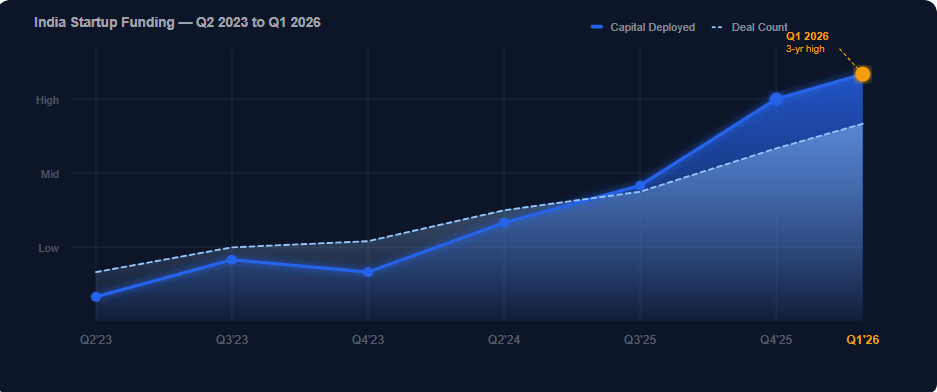
Total capital deployed across Indian startups in Q1 2026 reached ₹18,240 crore — a 23% increase over Q4 2025 and the highest single-quarter figure since Q2 2023. Deal volume reached 1,847 transactions across all stages, from angel to late-stage growth capital.
The most significant shift isn’t the headline totals — it’s the composition. Pre-seed and seed-stage deals now represent 67% of the deal count, a dramatic shift from the Series B-and-above concentration in 2023–24. First-time founders are raising their first ₹25–50 lakh checks. New angels are writing their debut tickets. India’s startup formation rate has quietly recovered to 2021 levels.
The quality of deal flow has improved dramatically — but finding it still requires an enormous amount of manual effort and trusted network access.
— Composite sentiment from 40+ angel investor interviews, Q1 2026
Yet the infrastructure connecting founders to capital remains fragmented, unstructured, and noise-dominated. Despite 21,500+ registered angels and 6,500+ VC funds in India, the median angel investor still evaluates fewer than 3 investment-ready deals per month. This is not a capital supply problem. It is a governance and discovery problem.
1,847 deals. Where they went — and what they tell us
Q1 2026 volume broke three years of compressed deal counts. But the composition — not the total — is the real story.
Early-stage dominance is the defining characteristic of Q1 2026. Angel and pre-seed deals accounted for 47% of all transactions — the highest share on record. When combined with seed-stage activity, early-stage rounds made up two-thirds of India’s entire deal volume. This is a structural shift, not a cyclical blip.
Where capital is flowing — and where it's being avoided
B2B SaaS retains its crown. But the breakout story of Q1 2026 is Deeptech — and the quiet retreat from pure consumer plays.
The Tier 2 revolution is no longer a hypothesis
For the first time, cities outside Bengaluru, Mumbai, and Delhi-NCR account for more than 35% of total deal volume. The map is redrawn.
The geographic concentration that defined Indian startup funding for a decade is fracturing. Hyderabad, Pune, Chennai, and Ahmedabad have emerged as genuine formation hubs — not satellite offices, but cities with indigenous angel networks, VC presence, and local talent pipelines driving original deal creation.
India's angel ecosystem is professionalising — and hitting a wall
The most underreported story in India’s venture landscape is the rapid maturation of its angel investor base. What was once an ad-hoc network of ex-founders and HNIs writing relationship-driven cheques has evolved into a structured, thesis-driven community — with one critical exception: the infrastructure supporting it has not kept pace.
Why India needs a governed marketplace — not another directory
The existing infrastructure for startup fundraising has four categories — and a critical gap that none of them fill
What comes next — and three things to watch
The Q1 momentum creates a strong foundation for continued activity. Several structural tailwinds suggest the recovery is durable: global interest rate softening is increasing risk appetite among institutional LPs, India’s GDP trajectory remains the strongest among major economies, and a new cohort of second-time founders with operational credibility is entering the market.
Three variables to watch in Q2 2026: First, SEBI’s evolving AIF framework — regulatory clarification will either catalyse or constrain syndicate formation. Second, seed valuations have crept ahead of revenue metrics, creating potential for a 12–18 month correction at that stage. Third, US-China trade disruption could tighten international LP capital flows into India if escalation continues.
“Our base case: Q2 2026 sustains momentum with 5–8% deal count growth. Full-year 2026 on track to exceed 7,000 transactions — and the Tier 2 city surge is just beginning.”
— Venture Suite Research, March 2026
How this report was built — by Venture Care
This report is produced by Venture Care’s research division using a multi-source triangulation methodology. Every data point is cross-verified across at least two independent sources before publication.